
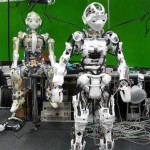
 (NC & T) Humanoid robots today can walk, but can not interact with the world. Khatib and his collaborators are working to develop robots with the capability to physically touch, push and move objects.
Khatib’s project is one aspect of Project Honda Humanoid Robot, which aims to build robots that can easily deal with humans and can perform useful tasks in complex, changing environment. Honda recruited Khatib to work on his project after executives impressed company in 1995 with his twin robots Romeo and Juliet, mobile robotic arms that can cooperate to perform complicated tasks.
His inspiration for this new generation of robots came from humans. Khatib assumed that humans perform physical tasks in ways that minimize effort and discomfort. We use the mechanical advantage of our bodies to perform the tasks postures that minimize the muscular effort.
Khatib was associated with Professor of Bioengineering and Mechanical Engineering Scott Delp to investigate issues of interest to robotics about how we move humans. The researchers used sensors to accurately track the movements of human subjects engaged in acts such as bending, walking and jumping.
Based on these observations, Khatib and his team have constructed a multivariable model that minimizes human muscular effort for each position and produces a smooth scrolling through which a simulated robot can move a computer to perform the assigned task.
The robot, using this strategy for energy minimization produces trajectories movements without explicitly planned in advance on the computer, something that instead it is done in conventional methods of robotic motion, which can consume large computing resources. Khatib compares the process of “thinking” robot with a ball rolling down a hill. Based on the laws of physics, the ball automatically finds the lowest energy path to reach the bottom of the hill.
For within a year, Khatib hopes to see their ideas in one of the Honda humanoid robot, ASIMO. Although this robot seven-year-old can walk, run and greet people passing near him, still unable to perform useful tasks in the complex world of humans. With the new software Khatib, ASIMO may in future tasks such as ironing and clearing tables.
The robots like ASIMO also be able to interact with humans in a way that does not involve any danger to us or that we would be overly complex. Only by fulfilling these premises will achieve in our environment or gained popularity beyond the anecdotal. For example, to shake hands with one person safely, a robot must know the appropriate pressure applied.
Experts working in Khatib’s lab have designed innovations to ensure that the robot is not hazardous to physically interact with humans. These improvements include robotic arms that use multiple motors instead of one, allowing the pressure to better regulate and ensure that the robot gently touch people. In this issue of improved security in the treatment accorded to the human robots, says robots Khatib generation ASIMO comes after will be an order of magnitude safer than the typical robots today.