

A tiny device a quarter of a millimeter in diameter would be able to trace the blood in an artery to an area to operate and use miniature instruments, controlled remotely by a surgeon. This scenario is coming out of science fiction …
For now, the nanochirurgien able to slip into an artery does not exist yet. But an Australian team at Monash University, headed by James Friend, had described a prototype in the Journal of Micromechanics and Microengeenering.
This tiny device includes a helical rod of 250 microns in diameter, a quarter of a millimeter, which can be rotated with a very low current. Stator called, it begins to run under the effect of a piezoelectric element. Commonly used, such material – a crystal – a property to come into effect under the vibration of an electric current, or, conversely generate a flow at the slightest shock. The lighter gases are an example of applications, as well as engines of electronic watches and reading heads of some turntable too ancient.
The prototype seen around (click the image to enlarge). The stem is helically grooved stator and measures a little over 1 mm in height to 250 microns in diameter. It can turn on itself and has a viewing sphere rotation. All depends on the piezoelectric element (gray). © J. Friends et al.
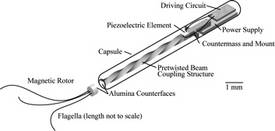
The rotation of the stator is transmitted to an element named rotor, a simple sphere on the prototype developed to validate the concept. But it could be replaced by a propulsion system. On its web pages, James Friends shows a schematic (bottom of this article), where the small craft is equipped with two flagella.
Fantastic voyage
The prototype has demonstrated the feasibility of such an engine in the required dimensions for insertion into an artery. Because in the long line of assistance to robotic surgery, it is the destiny of this device. Its designers have also called Proteus, named after the submarine microscopic imagined by Isaac Asimov’s new Fantastic Voyage, taken to the cinema in a movie together. It shows a crew miniaturized human but also introduced with the submersible in the body of a man to go destroy a blood clot in the brain which will effectively use in brain
cancer
.
Such a mission could one day be entrusted to a machine as Proteus. With a rotation of 1295 revolutions per minute, miniature robot that could, say the researchers traced the flow of blood if it is not too powerful, for example in the brain, but not near the heart where the gear would be taken away.
For now, the device has no source of energy but it could be powered by electromagnetic waves of around 2 to 3 watts. He then left to develop an instrument. A camera would be a possibility but we can imagine any sensor or small micro-mechanical systems (MEMS, Micro Electromechanical Systems), today studied. This is the next step …